Garden Posies and the Rise of the Formal Bouquet
See how garden posies and formal bouquets took different paths, then choose a seasonal flower style that suits your stems and the way you will present them.
Why does a garden posy feel gathered, while a formal bouquet looks composed? The difference is partly practical: a handful of flowers cut for a small vessel asks for less structure than stems arranged to be carried or presented. Their histories are not a simple progression from rough to refined; they reflect different uses, materials and fashions.
Posies and bouquets have overlapped for centuries, and the names have never described rigid recipes. A posy often means a small bunch, sometimes scented, while bouquet can mean flowers gathered together or a more carefully designed arrangement. The useful distinction is what the maker is asking the stems to do.
Posies for Hand and Home
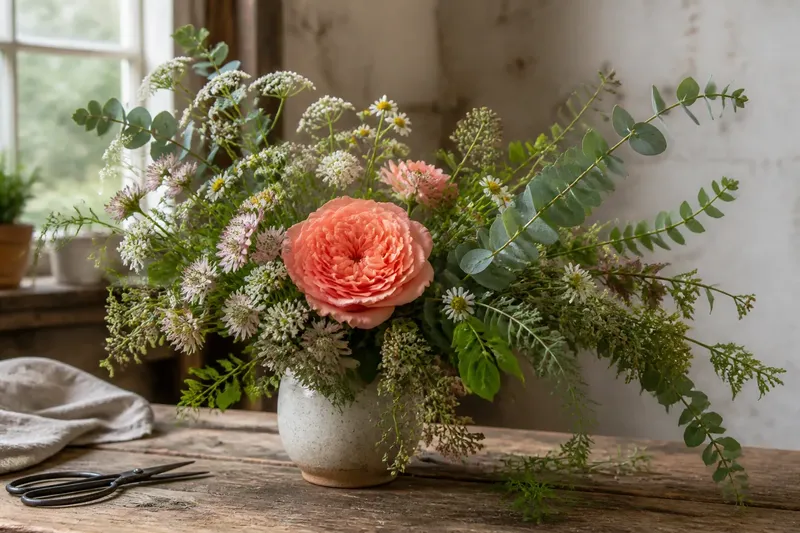
The word posy has long been associated with a small bunch of flowers. In earlier European customs, fragrant herbs and flowers could be carried or worn, making scent part of their appeal as well as their appearance. The precise contents varied with season, place and access; there was no universal posy recipe.
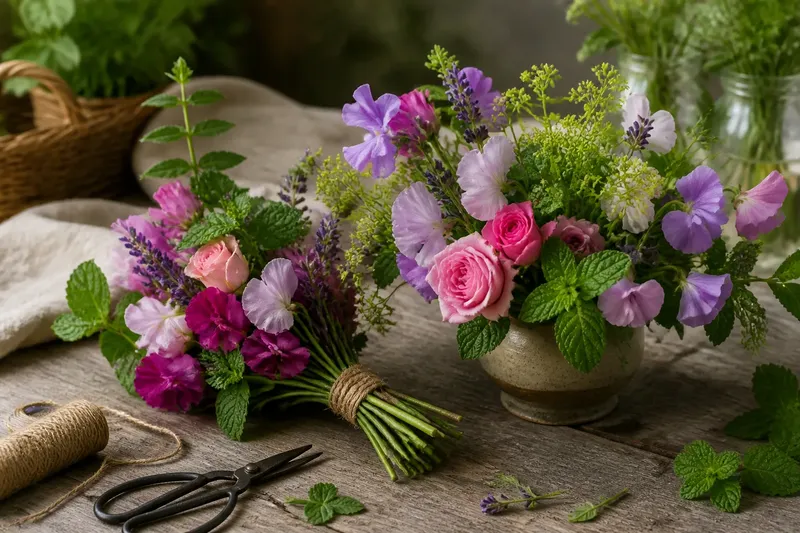
In Britain, a garden posy could draw on whatever was flowering nearby: violets or primroses in spring, roses and sweet peas in summer, or herbs such as rosemary and lavender. These examples describe possibilities, not a fixed calendar. A small gathering could be placed in a little vase, offered as a token or held in the hand.
The posy’s scale suited close viewing. It might combine flower heads, foliage and fragrant herbs, with no requirement for a symmetrical outline. Its informality did not mean an absence of choice: selecting compatible stems and gathering them securely still involved judgement.
For a posy, start with what is open and let the handful determine the shape.
Bouquets for Display
As flower arranging became more closely associated with gifts, ceremony and interior display, the bouquet offered a way to organise stems for a particular purpose. In European courtly settings, elaborate floral display became part of the visual language of wealth and hospitality; later, commercial floristry made arranged flowers more accessible beyond elite households. These developments were uneven across places and periods, so they are better understood as overlapping changes than as one clean historical turn.
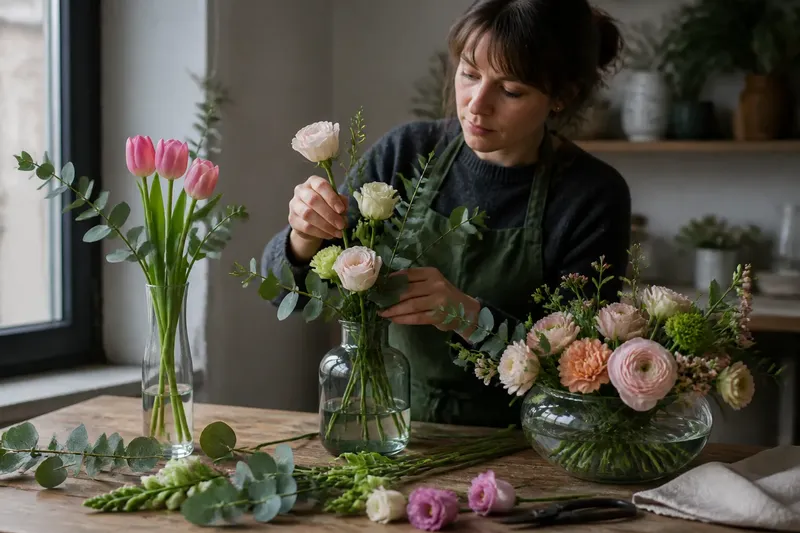
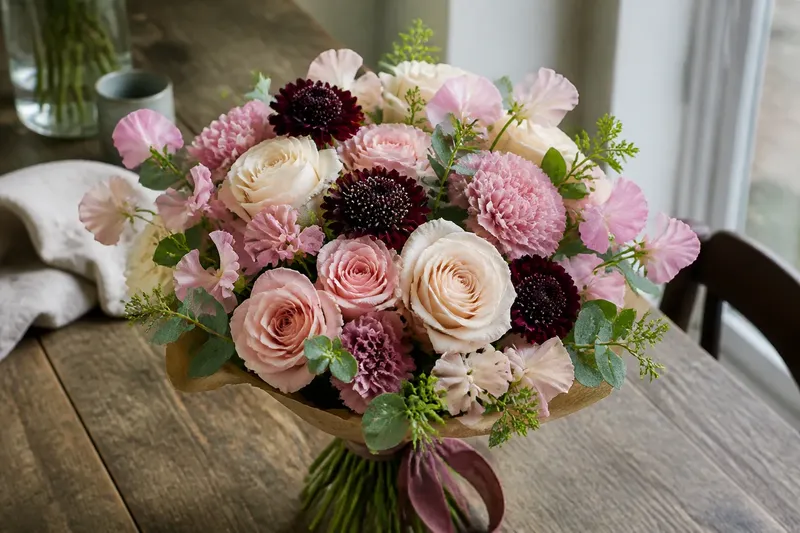
A bouquet designed to be carried needs a secure gathered point and blooms visible to the person receiving it. One made for a table may be arranged for a view from several sides. Florists can use a spiral hand-tie, with stems crossing around a central point, or arrange directly into a vessel. Neither method alone makes an arrangement formal; the intended outline, balance and finish do more to establish that impression.
Trade and transport widened the flowers available to some buyers, while local gardens continued to supply seasonal material. Access differed by place, means and period. Imported blooms were never a requirement for a formal bouquet: deliberate selection and placement can give locally grown stems a composed appearance.
Choose the viewing angle before deciding how much structure the bouquet needs.
Different Forms, Different Jobs
A posy and a formal bouquet are not rival stages of floral progress. One tends towards a small, gathered scale; the other often puts more emphasis on a planned outline and presentation. Either can be made from garden flowers, purchased stems, foliage or herbs.
- Check the use: if the flowers will be carried, gather the stems firmly and keep the blooms visible; if they will sit on a table, arrange them for the room’s main viewing angle instead.
- Check the quantity of material: if you have only a few stems, keep the gathering compact; if you have a varied armful, sort by height and use foliage to connect the groups.
- Check stem lengths: if they are close in length, a tied bunch may be straightforward; if they vary widely, trim or group them so shorter flowers do not disappear.
- Check the flower shapes: if the heads are delicate or irregular, leave space around them; if they are similar in size and form, a more even outline may suit them.
- Check fragrance: if scented herbs or flowers are part of the appeal, keep them near the centre or edge where they can be noticed; if the recipient may prefer little scent, leave them out.
- Check the vessel: if it has a narrow opening, gather the stems closely; if it has a broad opening, use foliage or a grid of crossed stems to keep the flowers from spreading flat.
Say you have three sweet peas, two small roses, several mint sprigs and one tall piece of foliage; those numbers are invented for this example. First, set aside the foliage and remove any leaves that would sit below the waterline. Next, hold the flowers together loosely and turn the bunch until each rose and sweet pea is visible. Add mint around the outside, then use the foliage as a modest back line. If the bunch is for a neighbour to carry, tie it at the crossing point and leave a comfortable stem grip; if it is for a squat vase, shorten the stems and spread them so the blooms face different directions. The first choice produces a small hand-held posy, while the second gives the same material a lower, room-facing arrangement.
Seasonal Material and Style
Seasonality shapes both forms, but it does not dictate them. Spring branches can supply height, while delicate flowers may be best left with space around them. Summer often brings a mixture of blooms and herbs; autumn foliage and seed heads can add texture. What is available varies with garden, region and growing conditions.
Work with the stems in front of you rather than trying to reproduce a seasonal picture from elsewhere. A few branching stems may be more convincing as a loose posy than as a dense, tightly controlled bunch. Conversely, a group of similar flowers can support a clean, formal outline without losing its seasonal character.
Let the material set the scale, then decide whether the occasion calls for a tied presentation or a looser gathering.
How Do Posies and Bouquets Differ?
What is a garden posy?
A garden posy is usually a small gathering of flowers, often with foliage or herbs, chosen from what is available. It may be held, given or placed in a small vessel.
What makes a bouquet formal?
Formality comes from the planned outline, placement and finish rather than the price or origin of the stems. A local, seasonal bunch can look formal if it is arranged deliberately for its use.
Can a posy be a gift?
Yes. A posy can be tied for carrying or left as a loose gathering, depending on how it will be received and displayed. Its small scale can make a gift feel personal without requiring elaborate materials.
Does a bouquet need imported flowers?
No. Imported flowers may broaden the available selection, but they are not a condition of bouquet-making. Garden flowers, foliage and herbs can all be organised into a composed arrangement.
Choosing the Right Gathering
Start by deciding where the flowers will go: in someone’s hand, in a small vase or on a table viewed from several sides. Then look at the number, length and shape of the stems. A handful of mixed garden flowers may make a better posy; a carefully sorted group may benefit from a more deliberate outline.
The history of garden posies and formal bouquets is less a story of one replacing the other than of different purposes sharing the same material. For your own garden posy or formal bouquet, choose a form that suits the stems and the way they will be seen. Secure a carried bunch well, and keep any foliage below the waterline out of the vase.