Why a Focal Flower Changes the Shape of an Arrangement
Learn how a focal flower changes an arrangement’s shape, and choose supporting stems that frame its presence without crowding the design.
Why does one flower make a bunch look broad, upright or unexpectedly lopsided? In a cut-flower arrangement, the focal flower sets a visual centre: the eye lands there first, then reads the stems around it in relation to that bloom. Choose the right support for its size, position and character, and the arrangement feels intentional rather than like a collection of flowers that happened to share a bucket.
Start with the focal bloom
A focal flower is the bloom with the greatest visual pull. That may come from a large head, a distinctive silhouette, a strong colour, or a position that makes it easy to see. A peony, dahlia, sunflower or open rose can draw attention through its face and scale; a single unusual anthurium may do so through its outline instead. The role depends on the particular combination, not a fixed list of flowers.
Look at the bloom from the place where the arrangement will usually be seen. A round, forward-facing head makes a clear centre from the front. A nodding or side-facing flower may draw the eye along a diagonal. Several equally large, equally open blooms can share attention, but they may also create several competing centres. Decide whether that lively effect is wanted before adding more stems.
The focal flower influences the shape because the surrounding stems appear to point towards it, frame it or push against it. A low, broad bloom can make nearby stems seem to spread sideways. A tall, upright flower can encourage a vertical reading. A stem that leans out from the centre may turn a compact cluster into an asymmetrical outline. The flower has not altered the vase or stem length; it has changed how the eye interprets their arrangement.
Choose by shape
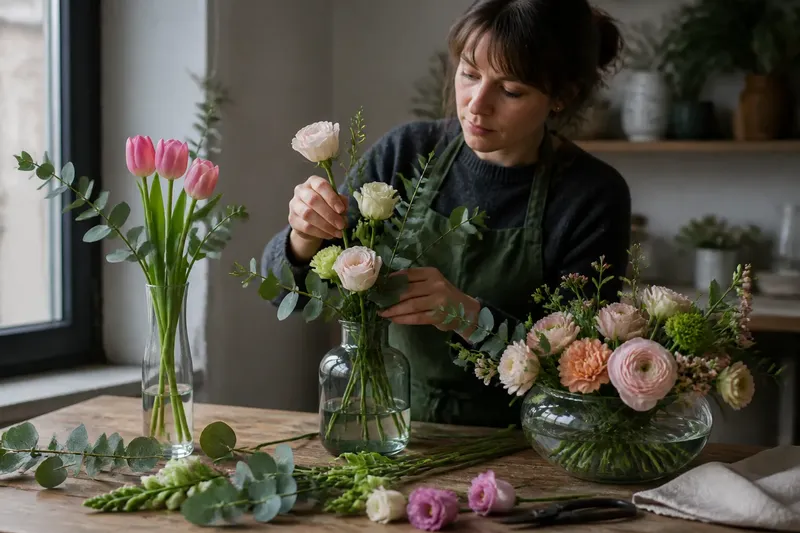
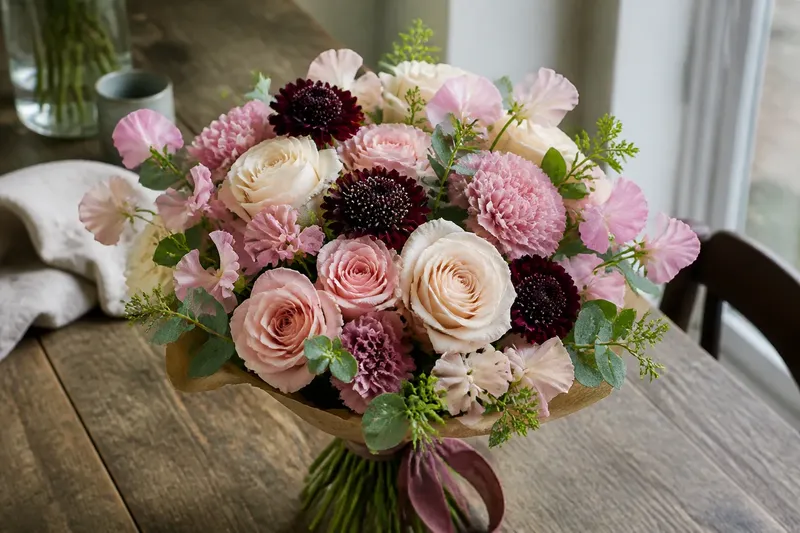
If the focal bloom is broad and rounded, give it some breathing room. A few airy stems, such as cosmos or branching foliage, can soften its edge without masking its face. Fine, branching material makes a useful transition between the solid flower head and open space. A tight ring of similarly dense blooms can make the centre look heavy, especially if all the heads sit at the same height.
If the focal flower is tall, narrow or strongly directional, use supporting stems to establish whether that line continues or is deliberately interrupted. A slender spike of delphinium or snapdragon can echo an upright bloom, while a lower, arching stem can keep the arrangement from reading as a rigid column. Repeating the line in more than one place makes it seem considered; one isolated spike can look like it has missed its cue.
If the focal flower has a complicated outline, as with a many-petalled dahlia or an irregular iris, keep the nearest companions simpler. Smaller, quieter flowers can fill gaps without competing for the same attention. If the focal bloom is visually simple, such as a clean-faced tulip, a little more variation in nearby textures may enrich the arrangement. The useful question is not whether every flower is impressive, but whether each has a clear job.
Match the support
Use supporting stems to do one or more of three things: frame, balance or soften. Framing means placing lines or smaller heads around the focal bloom so its outline remains legible. Balancing means adding visual weight on the side that feels empty, not necessarily putting an identical flower opposite it. Softening means using finer textures or curved stems to ease a hard edge or abrupt change in height.
- To frame: place smaller blooms just beyond the focal head, leaving enough open space that its shape remains visible.
- To balance: add a stem with comparable visual weight on the lighter side, even if its colour or flower form differs.
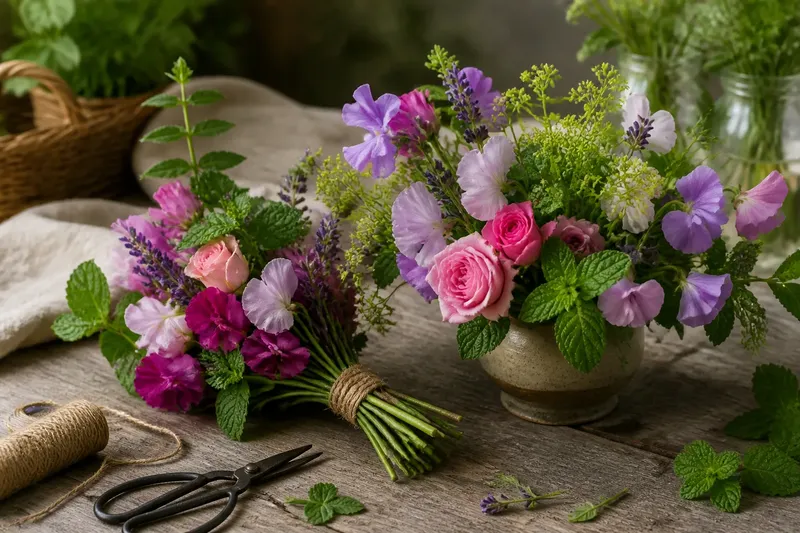
- To soften: use airy foliage, small branching flowers or a gentle curve near a dense or angular bloom.
- To extend: let a few longer stems continue the direction already suggested by the focal flower.
Support does not have to mean symmetry. A large bloom placed slightly off-centre may feel stable when a loose spray of smaller flowers extends in the opposite direction. The balance comes from the overall visual weight and the paths the stems create, not from matching pairs. If the focal bloom is already surrounded by dense heads, add open material rather than another solid mass.
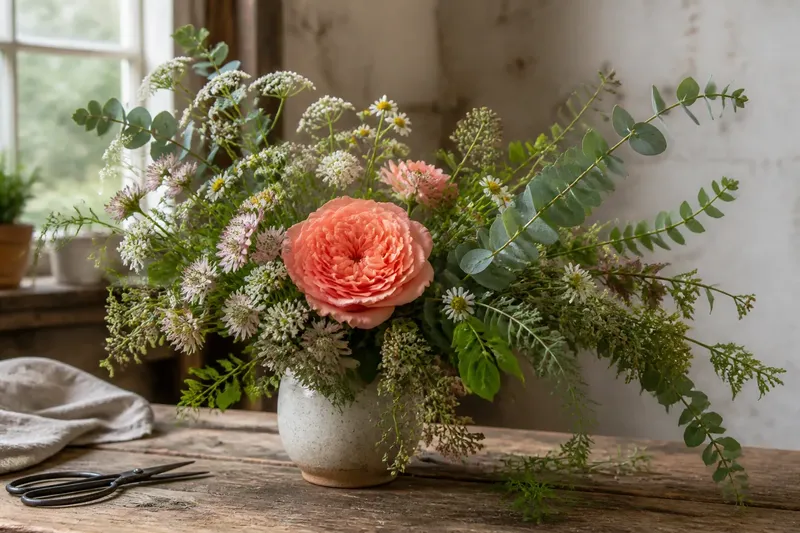
Say you have one open coral rose, a handful of small white spray flowers and several stems of eucalyptus. If the rose sits low and near the centre, the spray flowers can trace a loose frame above and to one side, while a eucalyptus stem extending the other way can counter its weight. The expected result is a shape that feels broader and gently off-centre, with the rose still easy to find. Moving every stem to an even height would instead make the arrangement more compact and less directional.
Choose by situation
For a clear centre: choose one focal bloom with a distinct face and surround it with smaller, quieter stems. This suits a simple arrangement where the eye should settle quickly. Keep nearby flower heads from crowding the focal bloom’s outline.
For a loose, outward shape: choose a focal flower that can anchor the centre, then add branching stems that travel beyond it. This suits arrangements meant to feel open or informal. Let the extensions vary in direction rather than forming a uniform halo.
For an asymmetrical shape: place the focal bloom to one side and use a few stems to carry visual weight across the arrangement. This suits a design with a clear direction, such as a line that rises and then sweeps outwards. Check the arrangement from its main viewing side; a balanced outline from one angle may be blank from another.
For a softer outline: pair a bold focal head with fine foliage or small flowers that blur the transition into open space. This suits a bloom whose edge feels abrupt beside the other stems. Keep the soft material around the perimeter or behind the bloom rather than laying it across the face.
For several focal blooms: group blooms of similar visual weight rather than spacing them evenly as separate centres. This suits a fuller, more clustered effect. A small change in height or angle can make the group read as one larger focal area instead of a row of unrelated heads.
When does the focal bloom need help?
How many focal flowers should an arrangement have?
One is often easiest to read, while a small group can work when the blooms share similar visual weight and sit close enough to form a cluster. Several large heads scattered evenly may compete for attention. Choose based on whether you want one clear centre or a broader area of emphasis.
What should go beside a large flower?
Use smaller or more open stems if the large flower already has a dense shape. Fine foliage, branching flowers and lighter flower heads can preserve space around it. Add another substantial bloom only if you want the centre to become a group rather than a single point.
Can a small flower be the focal point?
Yes, if its colour, silhouette or position gives it greater visual pull than the surrounding stems. Place it where it can be seen and keep nearby material quiet enough to make its outline distinct. Small size does not prevent a bloom from leading the eye.
How can I tell if the arrangement is unbalanced?
View it from its main display angle and notice whether your eye is pulled off the arrangement, or whether one side feels much heavier than the other. Try shifting one supporting stem or changing its angle before adding another flower. A balance adjustment often comes from direction and spacing, not extra material.
Make the final adjustment
Before adding another stem, turn the arrangement towards its intended viewing side and look at the outline. Can you identify the focal bloom without searching? Do the supporting stems frame, balance or soften it, or are they asking for equal attention? If a stem hides the focal flower’s face, move it. If the arrangement feels too compact, remove or redirect a dense companion rather than adding more height by default.
Work from the focal bloom outwards, adjusting one stem at a time. This keeps the arrangement’s shape legible while allowing small changes in angle and distance to do their work. The focal flower need not be the largest or loudest bloom in the room; it only needs enough space, and the right company, to lead the eye.